Pages

Translate

Sunday, November 15, 2015

Curry, my first Alaska Ghost Town

We were still riding the Hurricane Train.  Still no bears, but some pretty gorgeous scenery presented itself.  We didn't see any more wildlife, but I am certain that as soon as the loud, clattering train passed, some moose or bear (with an adorable nub of a tail that I would have loved to photograph) breathed a sigh of relief and went back to enjoying the tranquility of this mostly human free zone.
They probably waded though this pool as soon as we were gone.


The turnaround point for the train (and by turnaround I mean reverse) was Hurricane Gulch.  Hurricane Gulch was one of the most challenging sections of the Alaska Railroad.  The Gulch spans a distand of 900 feet.  The dept?  300 feet.


Definitely wouldn't want to fall.  Although one poor guy tried to commit suicide here a few years back.  He jumped, fell 300 feet, and lived long enough for rescuers to reach him, load him in an ambulance, and almost get to the hospital.


Shadow of the train on top of the bridge on the moutainside.  The bridge is an arch -- the whole project was completed back in 1921 in the unbelievable time frame of 60 days, start to finish.


At are rare stop, we got some photos for Shibby's Alaska scrapbook.


Pretty little river, pity we didn't stop for a bit longer.


I think Fireweed is going to mean Alaska summer to me from now on.  Since this is my first summer in Alaska, I didn't realize how short a season it would be for this plant.  It comes with the warmth of summer, and in the long Alaska days, it feels like summer is going to last forever.  But it doesn't.  It's just a few weeks later that you start to spot yellow leaves, and then the fireweed dies, and winter comes.  But I didn't know that when I took another picture of Alaska framed by my favorite purple weed.


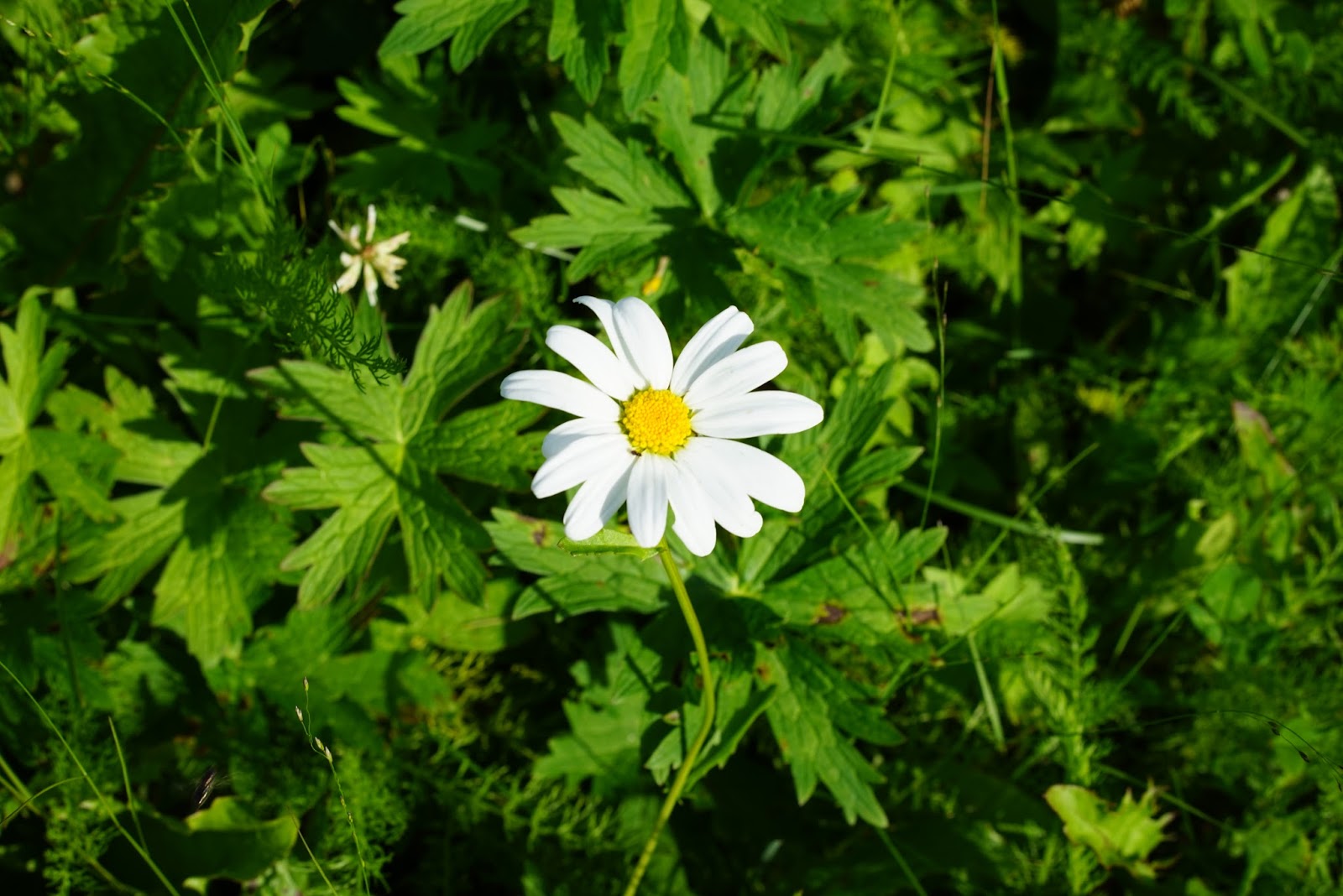
I did find a few other tiny wildflowers.


But soon we were on our way back to Talkeetna.  I was determined to catch a picture of Curry on the way back.  We passed it so quickly on the way out that I missed it.  And it wasn't until they started talking about the history along the train line that I learned what Curry was.


Zooming very quickly past the Curry trainstop.  Population of Curry now...0 it seems.


There it is! Curry Alaska.  This story was probably the most interesting one for me on the train.  I was dismayed when I tried to find it on Wikipedia and found no mention of it, so I had to do my own research and make my first Wiki entry and make sure the story got its rightful place in the archives of the internet.


The old townsite of Curry is now an uninhabited stop along the Alaska Railroad, about 22 miles north of Talkeetna. In 1922, this remote train station in the Alaska wilderness became a briefly popular luxury resort destination. Located halfway between Seward and Fairbanks and alongside the Sustina River, Curry was billed "a wilderness palace' when the Railroad opened the first hotel in 1923. Curry was the perfect overnight stop for rail passengers, and with the hotel and renowned fishing, became a destination spot of its own. The little town blossomed, and the resort became more popular as it expanded to include a golf course, a suspension bridge, and boasted magnificent views of Mount Denali.
Curry was plagued by a series of unfortunate events leading to its ultimate demise. A fire in 1926 destroyed the engine house and power plant. The engine house was again destroyed by fire in 1933. The construction of a larger hotel in Denali National Park in 1939 drew visitors away from Curry, but the Railroad continued investing in the town, housing employees there in 1945. Disaster came again in the way of a boiler explosion in 1946, completely destroying the power plant. Curry rebuilt, and added a ski area, which would be popular for years to come. The final disaster, however, was a fire in April 1957, in which fire burned down the town's lifeblood, the 75 room hotel. Three people were killed in the blaze. The hotel was never rebuilt, and Curry faded away.
Today you can get off and explore the site on the Alaska Railroad's Hurricane Train, or take one of the rafting expeditions from Talkeetna that go up the Sustina River.

It seems hard to imagine this little spot as a thriving resort, but it's also true that one cannot tell what the woods open up to beyond the train.  At the very least, it seems like there is an area worth exploring beyond that train stop....but I think I might want to go with a group of several people.  It's pretty remote.  I would be less excited about seeing a bear once the train pulled away, that's for sure.

A little white later we passed this train stop sign, indicating more hiking paths.  And an answer to the age old question that every stumped every Canadian kid for the past 40 years..."Can you tell me how to get to Sesame Street?"  Not a bad way to finish off the train ride.

Saturday, November 14, 2015

To Paris with Love

I have never been to Paris.  I would love to go.  I will get there one day.  I thought I was quasi apolitical, as my following of news is more closely linked to the scientific than the political.  Prior to this morning, I could not have told you who the leader of France was (and maybe that's a little sad on my part).

In the stereotypes in my mind, Paris is a relaxed city, filled with culture, art, light, delightfully long springtimes, and a whole lot of wine and berets.  People probably don't wear the berets, but that's what usually pops to mind.  The images in my mind are formed by the stories of others...pictures, movies, books.  There has been a common theme though -- Paris has been romanticized for decades...yes for the romance between people, but what I really mean is that the city has been romanticized globally.  We expect it to be beautiful, idyllic, and under the eternal warms of spring days and summer nights.  We expect wonderful things to happen there.  Because it's PARIS.

I have seen some posts on social media asking why are suicide bombs in Paris receiving more media attention than suicide bombings in other places at other times this year.  I can't believe anyone wants to compare scorecards at a time like this, but OK, let's talk about it.  News reports say that 153 people were killed in Paris last night.  If the claim by a terrorist cell that I won't even speak the name of is true and that jet was brought down by a bomb, that's 224 people killed Oct 31st.  102 people died October 10th in the suicide bombings in Ankara, Turkey.  September 20th saw 145 die in Maiduguri, Nigeria in bombings.  July 17th saw "100+" killed in Khan Bani Saad, Iraq in suicide car bombings.  July 1st and 2nd saw a horrible shooting rampage killing 145 in Kukawa, Nigeria.  On June 25th, 145 were killed in Kobani, Syria with detonated car bombs.  147 were killed on the University campuse in Garissa, Kenya on April 1st.  On March 20th, 137 were killed by 5 bombs in Sana'a, Yemen.  And possibly the largest loss of life at all, in the Borneo State of Nigeria, a massacre occurred between January 3rd and 7th.  At least 100 bodies were found, 2000 people were unaccounted for and feared dead.  That's just 2015, and those are just the ones with 100 or more fatalities.  That doesn't include other well publicized terror attacks in 2015 in the Phillipines, in France, in the Ukraine, Pakistan, Saudi Arabia, and Cameroon which had large losses of life, or the starling almost daily record of 1-20 deaths globally.  Some places-- Iraq, Nigeria, Israel, Jerusalum, and Cameroon seem to be hit with more frequent event, including hate crimes, where a single person or is attacked for being of a certain religion.  We could blame the media for not giving equal attention to every life.  But the media is just being the media.  When we want to educate, and cultivate thought, we turn to school and Universities, the education system.  Let's not confuse media with education.  Media is a method of spreading information that catches the interest of people.  Not necessarily useful information.  Not the most important information.  Maybe not even the information people really want (seriously, who would have thought I would know who Caitlyn Jenner was before I could name the President of France.  Believe me, that wasn't in the order of things I was interested in).  And let's not confuse what's on the news with what people care about.  But what happened in France does catch my attention.  Not because France is more important, or because of the color of anyone's skin, or anyone's religion.  It catches my attention more because Paris is in my mind as a city of love, culture, and peace.  It catches my attention because it is not a place that has reported this type of mass casualty before in my lifetime.  It catches my attention because it means the global efforts to stop racism, war, and persecution from others is not diminishing but growing.  Spreading.  Every life matters.  In every place.  And the overall losses are global events in 2015 are staggering, and difficult to comprehend.

So while I hate knowing that there has been so much senseless intentional death inflicted in so many places, today the blood is fresh on the streets of Paris, and so my current thoughts are to those who have  just lost their lives, their families and friends; my heart goes out to them, whoever they are, whatever their race, faith, nationality, or religion.  I don't know yet who the victims were, but I expect they will represent the diversity of a modern nation with many races, many faiths, many histories.

Paris has not always been a peaceful place.  Paris has not always been idyllic.  A review of the history of Paris is quite interesting.  Origins of human habitation have been documented as far back as the neolithic, 9800 years B.C.  Paleontology knows the site of Paris had neolithic, likely agriculture based settlers that time.  As far as recorded written history goes, we only know about Paris from about 250 BC.  Those Parisians were actually a Celtic tribe known as the Parisii, and the settlement was known by as Ile de la Cite.  They built a bridge across the Seine, which opened trade routes and made them wealthy from the bridge tolls.  The Greeks wrote of the city as Lucotocia, the Romans wrote of it as Leucotecia.  Julius Caesar came with war in 52BC, and the Romans took over, and rebuilt on a slightly higher bank and called the city Lutetia.  There was of course, a couple hundred years of crisis and violence between Christianity and the Romans, and then the Germanic Invasions began around 275 AD.  The residents built a walled city, and by 305 the city was no longer recognized as Lutetia, but simply, the City of the Parisii, or Paris.  Interesting side fact: in 360 AD, a nephew of Constantine named Julian lived in Paris and was declared Emporer, briefly making Paris the capital of the Western Roman Empire.  But that was short lived because Julian died in 363 fighting the Persians.  War again for Parisians.  War war war.  Then there were the Barbarian hoards, which finished off the Roman Empire.  In 451 Parisians prepared to defend against Attila the Hun, but he passed them by and attacked Orleans.  In 461 it was the Franks.  In 508, Clovis of the Franks make Paris his capital.  Paris was kind of peaceful for a couple hundred years, and it physically and spiritually grew.  Violence arrived again in 885 with the Vikings, but the Parisians held them off for over 4 years, and entered into another period of peace.  The population doubled, Notre Dame was built, Universities were built, and Kings built palaces and fortresses, bridges and stone roads were built, commerce, economy, and architecture blossomed.  But then the Bubonic Plague hit Paris in 1347.  At least 50,000 died that year, and before it ran its course, 20,000,000 would die in Europe, 1/3 of the population of the continent of Europe.  Now add to that a fact that France and England were at war in this time (remember the 100 Years of War, Joan of Arc, and all that).  Paris actually lost 2/3 of its population to the plague and war between about 1345 and 1445.  Paris was a city of death, war, and hardship for about another 150 years.  Things got back on track around 1500, but in 1590 the city was under siege in another religious war and 50,000 citizens starved to death before the conflict ended.  Paris did well in the 1600's and 1700's, but social disparity grew along with the wealth, science, and culture in the age of enlightenment.  War was back in 1789 with the French Revolution, and part of this period was known as the Reign of Terror -- murder, riots, and destruction were rampant between 1792-1799.  Louis XVI and Marie Antoinette had their heads lopped off to a live audience in the public square, mass imprisonments and murders of both convicts and socialtes occurred, the cathedral of Notre Dame even had ITS spire lopped off a one point.  When the terror stopped who took the reins?  A man known as Napolean (the first one).  He got Paris into a bit of a pickle, and in 1814 400,000 coalition forces from Russia, Austria, Prussia, and England brought war to Paris.  Paris surrended within 1 day (its entire population, man, woman, and child was only 650,000).  A time of peace came again, and with it came growth.  There were more setbacks...cholera claimed 20,000 lives in 1832.  People fought for freedom of speech, more control, better social ammenities.  Riots in the city were regular in the 1830's.  Democracy arrived in 1848.  They elected Louis Napolean Bonaparte (the 3rd Napolean).  And that Napolean declared war on Prussia in 1870 (again), and they were beseiged (again), and the city of Paris plunged into starvation (again).  This led to a civil revolt where a group called the Commune took over, and before the army got control back a month later, 865 died, thousands were injured.  So France arrested about 45,000 people, and sent a great deal of them to foreign penal colonies.  And then for another 135 years, there was calm.  World War I.  Parisians did their best in that war -- in one notable battle Paris taxicabs drove the troops to the front lines because the country had no other way to get them there.  Paris was bombed by the Germans, and at the end of the war lost thousands to measles, typoid fever, and the influenza pandemic.  In World War 2, France was occupied by Germany from 1940-1944.  Single bombings claimed as many as 650 people in a single night.  12,844 French Jewish citizens were sent to Auschwitz.  After the war, finally, once again, a period of calm ensued.

As horrific as it is today, and as horrific as it was to the people in each on of the many historical events listed above, Paris has not been the city of peace it is to my generation.  It has had more than it's share of violence and tragedy.  It has experienced war, genocide, political persecutions, religious persecutions, and religious wars.  France fought similar battles that are today being fought in Syria, Iraq, Cameroon, Nigeria; just in a different time and with different tools.  France has attacked and been attacked from its neighbours, it has fought for and against its citizens, their faiths, their economic situations.  And after each conflict...it got a little better.  And in my lifetime, it has been in another period of peace and growth. This attack against the ideals of a country who has been there, done that, and found a better way to live is disheartening.  But, history repeats itself.  Paris will survive this too.  And it may take a while, but Paris will grow better.  And you know what?  Other cities can say the same thing.  Because the history of Paris is a story shared by all old cities in the history of civilization.  The bad guys will win some battles, but eventually, they too will fade into history like many other violent invaders throughout history.  Why?  Because statistically they are a much smaller faction of the human race.  They are outnumbered in this would by loving hearts, minds wired to build rather than destroy, and peaceful souls.  Time is the greatest ally of civilization and peace, and Time cannot be defeated.

Stand strong Paris.

Thursday, November 5, 2015

The Hurricane Train

So what the heck where we doing in Talkeetna anyway?  Well, there are a lot of ways to explore Alaska.  If you are exploring Alaska shortly after knee surgery, I highly recommend the motorized way (although in retrospect, if you are the surgeon or physiotherapist of someone exploring Alaska shortly after knee surgery, you might highly recommend the Discovery Channel way.  I believe the exact words when I showed up with a swollen leg to my followup appointment were "I meant you could walk around the block, not march off into the Chugach range!"  I never was very good at understanding implied boundaries).  So in my mind, driving to Talkeetna and hopping on board the Alaska Railroad was basically the same as resting on the couch, minus the ice pack.

So this is Warren.  He is the long-standing conductor of "The Hurricane Train," operated by Alaska Railroad.  


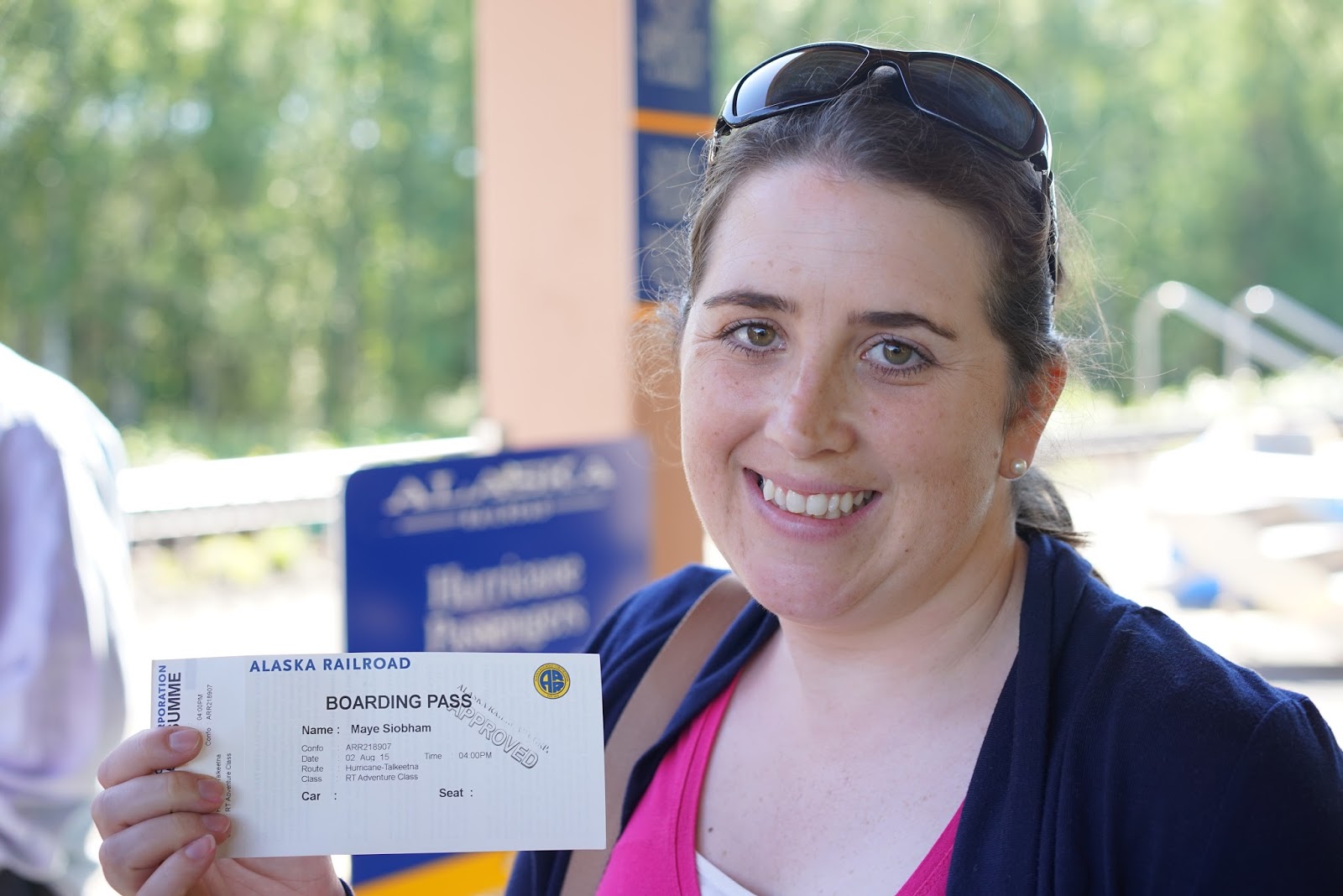
And this is Siobhan, who for the rest of the trip would be known as "Shib-ham" thanks to the spelling error on her ticket, which was far more amusing to me than her.


And here is the Hurricane Train.  Alaska Railroad trains are a stunning blue and yellow against the colorful Alaska landscape.  They go all the way from Seward and Homer (the southernmost tisp of the Alaska Highway system) to Fairbanks.  I have often admired them picturesquely winding around the mountains at Turnagain Arm.  The Hurricane Train is advertised as one of the most remote routes, that traverses where roads care not to go.  So we thought we would go see some wilderness.


Talkeetna is based near three major rivers, the Sustina, the Chilitna, and of course, the Talkeetna.  The Hurricane Train heads north and follows the Sustina river.  It's one of the last "flagstop" trains -- flagstop meaning you can get on, or off, anywhere you want to.  It operates on a quasi regular schedule, meaning it runs on certain days, and in a certain general time period, but no one knows who might want on or off, and where, so the schedule can be a bit random.

The Sustina River
The train had some snacks, and a coffee pot, but bringing your own lunch is highly recommended.  It's about a 7 hour journey round trip.  Warren the conductor stopped to pose for a picture with Shibham (hee hee), which seemed cool at first, but in retrospect it leaves me to wonder...who was driving the train?


Warren knew the area really well.  We were hoping to see herd of bear grazing in open meadows...this was unlikely from the start since bears don't do herds, but it was a secret wish all the same.  What we got, was a family of swans.


A little less thrilling than a herd of grizzlies...a little smaller too...this is the best zoom image I could get with a 55mm lens whilst on a moving train.


We did see a whole lot of beautiful scenery out there though.


After a few hours of the river, and grass, you start looking for something else to take pictures of.  That kind of leaves the train itself.


There are people who live up here, where there are no roads.  This couple has been living on this plot of land since the 60's.  No roads, no running water.  They probably see herds of grizzlies all the time.


This is probably my favorite picture of Shibby on the whole trip.  It made both of us laugh.


Every once in a while we would stop for a few minutes to stretch our legs.  Unfortunately, the train stops weren't like roadside turnouts overlooking a stunning vista...sometimes it was just a rare clearing where they had enough room to have two tracks between the river and the mountain...a train passing lane.  So at those spots, there wasn't much to photograph.  Still no bears, but here's some train tracks.


I did think the reflection of the scenery off the side of the train was kind of fascinating though.


Here's what oncoming train traffic looks like (still no bears).


No moose either, although I had hoped one would be in the marshy terrain.


This is how newspaper delivery works up near Hurricane Gulch.


And further to my forest fair footwear post, these feet boarded the train in the middle of nowhere.  Like thickly wooded, pathless, marshy forest middle of nowhere.  Alaskans have a flair all of their own.


One last picture of the train going around a corner.


Arrival at Hurricane Gulch...a one shack town, quite literally.  We would go just a little further down the tracks to Hurricane Gulch before turning back around.  The tracks head all the way to Fairbanks, through Denali National Park, but our little journey was almost over.


Sunday, November 1, 2015

Halloween Treat

Being a bacteria-whisperer is my gift.  My sister...she makes beautiful things.
I was one of those kids that didn't actually like Halloween.  My sister usually did, and I still remember the year she went as a cheerleader, in a fabulous teal blue satin movie-worthy costume that she somehow talked my conservative-minister-grandmother into sewing for her.  I, however, made my own and walked the 4 streets of the nearest small town in the saddest looking attempt at a Tinkerbell costume ever created.  It looked like a cross between crooked cardboard angel wings and a dunce cap...with Christmas tree garland glued on, and attached over my snowsuit.  It wouldn't be confirmed that I had no artistic abilities for a few more failed Halloweens.

My sister's ghostly yard


The first Halloween I remember is a brief snippet of a memory.  All I really remember was thinking that little white poodle looked nice.  I don't know what I was wearing, but I recall I was little enough to be carried home without any candy a few minutes later after it bit me.  Then there was the year the kids a year older waited until my friend Gisele and I had finished knocking on every door in town before jumping out of some bushes to steal our candy.  Gigi, as she was known, turned out to be more formidable than I expected, and the sight of her winding up her pillowcase of candy and clubbing the neighbour boy twice in the head and then dropping him with a swift kick to the nards is with me still.  By grade 5, I had decided no amount of candy was worth it.

I still don't like dress up, but over the years I have started to love watching people dress their kids up.  My nieces and nephews...Jaycena as a cow, Jordan as and elephant, Justy as a lion, Jaycena as Pocahantas.  This year I watch my former colleagues and friends parade about their mini Ewoks, Tree frogs, Ariel's, and notably, a bottle of ketchup.

Christmas had always been my favorite holiday.  But since my family lost Jaycena in 2009, I still find Christmas Day too painful without her to enjoy.  But last year, I was in Canada for October.  My sister, ever crafty (the cheerleader costume year was not a one off) asked me to spend Halloween at her house last year.  I found a little magic in the way she does Halloween.  Bags of leaves became ghosts.  Little spiders and webs lined the yard.  And she has become a pumpkin carving master.


I am not sure how far back the tradition goes, but at some point, pumpkin carving night became an event.  It started back when her kids were little, and pumpkin carving was something they loved.  These last few years, the yard has become a gallery.  The fabulous Doug and Monique always host pumpkin carving night, and it's safe to say there may be a cocktail or a cool one as the pumpkins are reinvented.  My sister's heart is always with Jaycena, and therefore Jaycena shines through in anything my sister puts her heart into.  Pumpkin carving is no different.  If you look carefully at the pumpkins, you will see tributes to the things on her heart -- a wistful looking young girl, hearts for Jaycena, Laramie, and Brooke.  A hockey player for Brandon.  A shaft of wheat for Kevin.  The heavy toll of so many losses in a small community in such a short period of time.  But also there are symbols of music, tradition.  Her gift to me last year, were two little pumpkins designed after my two kitties -- my copilots through my 20's, 30's, careers, countries; the two little friends who never left my side until the day they left this world.


Well, Halloween sort of got into my heart too after that.  So this year she mentioned she was gathering her pumpkins for the annual event, and I remarked on Skype that I was really sorry not to be there this year, I had enjoyed it so much last year.  "Well, go buy a pumpkin and Skype in to the pumpkin party," she said.  Genius!  And so I did...I found the perfect pumpkin, I made sure to leave work at a reasonable hour, and rushed home to Skype in and carve my pumpkin.  Step 1 of pumpkin carving is to match your model to your pumpkin.  Check!


Of course my model thought it might try to eat the canvas...


Step 2, open a bottle of wine, and initiate Skype call.  I was able to join my sister, nephew, brother-in-law, and Doug, Monique, Melissa, and Matt who I will just call family because I don't know how to define the connection...but they're stuck with me now :)  It was great to have a chat, see what they had all come up with, and little to some quasi-encouraging chortles as i tackled my pumpkin with a steak knife, since I still don't have a fully stocked kitchen up here yet.  My sister got a kick out of the fact that their pumpkin carving party was an international event with my dial-in.  By the end of the pumpkin carving party, the lights were turned out, and this was the end result!


And up here in Alaska, my solitary little pumpkin actually did look a lot like a panther....


The kids loved my pumpkin when trick or treating time arrived.  And Halloween was a bit of a treat for me as well.  I think this might become one of my new favorite holidays.

Saturday, October 31, 2015

Talkeetna

Talkeetna.  Just rolls off the tongue. If you practice I suppose.  Either way, Talkeetna was the next stop on the list.  This is the first Alaska adventure where I pointed the car north and started driving.  The first place I stopped to pull over was near a town called Willow.  In June of this year, a couple were leaving a cabin they rented, and lit some trash before they left.  People could still learn a lot from Smoky the Bear.  The fire quickly spread to over 7,000 acres, destroyed over 50 homes in the Willow area, and I can't even bear to think of the wildlife.  This is my first view of Willow. 


In fact, 2015 is one of the worst fire years on record for Alaska.  In a typical year, 600,000 acres of forest burn.  To date this year, 5,100,000 acres have burned.  It doesn't take much for the fire to jump roads, rivers and destroy generations in minutes.  I was curious about the trees, some had a distinct orange tone rather than a scorched black tone.  I hope that means they were not killed and may sprout leaves next year.


And of course, there was still beauty.  The palette of blue sky, green grass, black and orange, and purple fireweek.  Notably, another name for the Fireweed which is known to colonize areas after a fire, is Willowherb.  Fireweed makes the Alaska landscape a little more vibrant and beautiful in the summer.  It has a history of being a medicinal herb, and makes its way into tea, jam, jellies, chocolates, syrup, and honey.  I guess there will be a good crop for the local businesses who sell those next year.


A little fireweed up close.  The sad thing about fireweed, is that it seems to only shoe up for the brief summer.  It doesn't bloom until summer, and disappears before you even realize its fall.


The next stop on the road was Talkeeta.  It's a small town, but it pulses with summer tourists, and shines with the eclectic spirit of its residents.  It was actually hard to find a place to park for lunch.  Talkeetna's downtown is a national historic site (to be clear, there are only 879 residents of Talkeenta, so it's pretty much all downtown).  If you are a Cuba Gooding Jr fan, or if you liked Disney's Sled Dogs movie, it was set in Talkeetna.


Talkeetna has made the headlines a couple of times...even CNN.  You see, it's most famous resident is the town mayor.  As I mentioned in a previous blog, Mayor Stubbs happens to be a cat.  In a quirkly little place like this, you can understand how someone would nominate their cat over the other candidates...and even how the cat would get the most votes!  Mayor Stubbs retired from office in 2014 and now spends most of his time napping in the General Store, which is right where I found him.

Mayor Stubbs having a lazy afternoon in Talkeetna
I did eventually find a parking spot -- at the museum.  I was willing to pay the low admission to get a little history AND a parking spot.  In the museum I found a map of the language distribution of Alaska;s native peoples.  I am still a bit fascinated by these languages, as so many places are named after words in these languages.  Aialik.  De'nali.  Words that are in danger of having their meaning lost.  A terrible thought to a bookworm like me.


The museum had some old relics, like this sled.  I believe this was in the mountaineering exhibit.  I can't imagine trekking up a mountain dragging this thing.


And before Obama made it official, even the signs in Alaska tell the visitors that the mountain is known as Denali, meaning "The High One."


Nagley's store is basically the centerpiece of town, and was built by the family who were considered the pioneers of this area.


The energy of the locals artisans is evident everywhere.  I popped into this shop with the decorated moose right before I tried some home-made ice cream made from a creamer powered by an early 1900's John Deere tractor.  The town sits under the gaze of the high one, Denali, and is well worth a stop on your way to Denali National Park...which I have yet to get to.